Exhaust Systems Designed for Emission Compliance
Diesel Exhaust Repair in North Little Rock for trucks failing emissions tests and showing power loss
Exhaust leaks upstream of the turbocharger reduce boost pressure and cause rattling noises that intensify under acceleration. Red's Diesel & Auto Repair addresses exhaust system failures through manifold crack repair, DPF cleaning, and muffler replacement that restores proper backpressure and emissions control. Diesel particulate filter regeneration failures trigger check engine lights and force trucks into reduced power mode, requiring diagnostic scanning to determine whether the filter needs cleaning or complete replacement.
DPF cleaning removes accumulated soot through thermal regeneration or chemical cleaning processes when passive regeneration no longer clears the filter during highway driving. Emissions system diagnostics identify failed differential pressure sensors, exhaust gas temperature sensors, and NOx sensors that prevent regeneration cycles from initiating. Custom exhaust fabrication becomes necessary when aftermarket components don't align with factory mounting points or when performance upgrades require larger diameter piping.
Arrange an emissions system scan to identify which sensors or components are preventing proper DPF regeneration.
Why Exhaust System Integrity Matters Beyond Noise
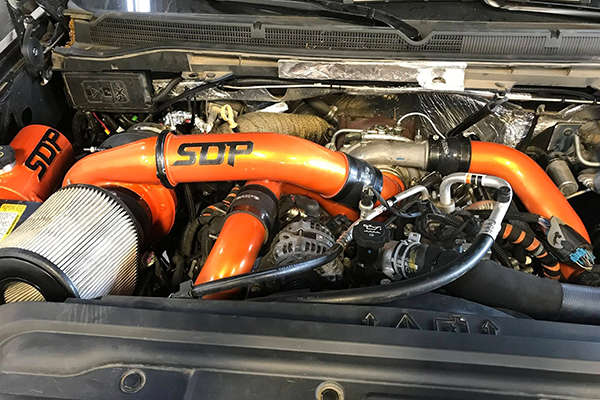
Muffler and piping replacement addresses corrosion damage common in trucks operating on salted winter roads or exposed to agricultural chemicals that accelerate metal deterioration. Performance exhaust upgrades reduce restriction through larger diameter piping and high-flow muffler designs that decrease exhaust gas temperature and improve turbocharger efficiency. Red's Diesel & Auto Repair fabricates exhaust routing that maintains ground clearance for off-road operation while positioning tailpipe outlets away from trailer connections.
Once exhaust repairs complete, your truck produces noticeably quieter operation without the ticking sounds that leak past cracked manifolds and loose flange connections. Engine braking effectiveness returns to normal levels since proper backpressure allows variable geometry turbochargers to function as designed during deceleration. Fuel economy improves when exhaust flow restriction decreases and the engine no longer works against excessive backpressure.
Exhaust leak repair often requires removing heat shields and skid plates to access corroded sections hidden above the frame rail. DPF replacement involves recalibrating the engine control module to recognize the new filter's parameters and reset regeneration intervals to factory specifications.
What Diesel Owners Ask About Exhaust Systems
Exhaust system repairs range from simple clamp replacements to complete system overhauls depending on corrosion severity and emissions component failure patterns.
What symptoms indicate exhaust manifold cracks?
Ticking noises that increase with engine speed, visible soot streaks on the manifold surface, and reduced turbo boost pressure all point to manifold cracks that allow exhaust gases to escape before reaching the turbocharger turbine wheel.
How often does the diesel particulate filter require cleaning?
DPF cleaning intervals depend on driving patterns, with trucks operating primarily in city traffic or idling extensively requiring service every 100,000 miles compared to highway-driven trucks that passively regenerate during sustained high-speed operation. North Little Rock trucks hauling in stop-and-go traffic accumulate soot faster than over-the-road vehicles.
When does DPF replacement become necessary instead of cleaning?
Filters with cracked substrates, melted cell structures from uncontrolled regeneration events, or ash accumulation exceeding design capacity require complete replacement since cleaning cannot restore structural integrity or flow capacity.
What causes performance exhaust systems to develop leaks?
Constant thermal cycling expands and contracts exhaust piping, eventually cracking welds at stress concentration points and loosening flange connections that rely on gasket compression to seal joints.
How does custom exhaust fabrication differ from bolt-on replacement?
Fabricated exhaust systems use mandrel-bent tubing cut and welded to match specific vehicle modifications, while bolt-on systems rely on pre-formed pipes with flanges positioned for stock chassis configurations.
Red's Diesel & Auto Repair maintains DPF cleaning equipment and exhaust fabrication capabilities for both stock and modified diesel trucks. Reach Red's at (501) 243-0190 to discuss exhaust system options appropriate for your truck's current configuration and intended use.